
Domain Authentication Education
How I educated 70K customers about an impactful technical topic and encouraged them to take action
The Challenge: A Technical Concept with Major Implications
In October 2023, Google and Yahoo announced new email domain authentication requirements, designed to reduce email spoofing. What this would mean in practice: if a customer used a Gmail or Yahoo email address as their “from email,” Google or Yahoo would bounce any email they sent to a Gmail or Yahoo inbox. Considering that over 50% of our customers’ customers had Gmail or Yahoo email addresses, this had big implications.
By 2025, Microsoft announced it would also enforce similar requirements.
There were 3 primary things my comms strategy needed to solve:
How to explain a technical concept to any customer, regardless of their tech-savviness. There were a ton of acronyms and jargon.
How to make the situation feel urgent without causing alarm. The impact of this change wouldn’t be seen until it happened, at which point it was hard to reverse.
The enforcement deadline was a constantly moving target, so we had to give nebulous dates while still encouraging action.
The comms would need to do a lot of heavy lifting. It would need to give context and educate customers, inspire action without hard deadlines, and make it clear that these changes weren’t unique to Mailchimp—a churn risk leadership was definitely concerned with.
Snapshot
Company: Intuit Mailchimp
Role: Principal Marketing Manager – Lifecycle, Customer Notifications
Scope: Led the email communication strategy for an evolving technical situation over 2 years, including multiple customer segments and comms to customer success managed accounts
By the numbers:
~ 70K accounts and ~140K email addresses reached per round of sends
5 customer segments, plus additional comms to customer success managed accounts
1 public newsroom post developed with corporate communications teammate
The final round of emails resulted in a 22% click-to-open rate, and a 450% increase in completed authentications
Part One: The 2024 Campaign and Lessons Learned
After the 2023 announcement, a cross-functional team of engineers, designers, and I met regularly to solve the issue. The product team started work on in-app guidance that my emails would link to, and I drafted the emails.
For this campaign, we had 4 customer segments based on their current domain authentication status. Each had different action items, so having only one email variation would cause confusion.
Once I drafted the emails, I worked with our corporate comms team to write a public newsroom post. This would show that we were thinking about this change, why we liked it, and clarify that it wasn’t something exclusively impacting Mailchimp. It’d be an artifact that customer-facing teams and Mailchimp partners could share instead of trying to explain it themselves.
When the in-app guidance work was launched, we sent the emails. Because these were transactional emails, we weren’t able to do any experimentation or testing. And because they launched alongside in-app messaging, we couldn’t determine how the email itself encouraged authentication.
Ultimately, Google and Yahoo delayed enforcement due to low compliance across the industry. Even with all the work we did, authentication wasn’t where we wanted it to be, which showed that it’s hard to drum up urgency with unknown deadlines and unseen impacts. These were lessons I’d take into part two of this project.
Part Two: The 2025 Campaign
In February 2025, Google and Yahoo announced enforcement would begin in Q2 of 2025 and continue through the rest of the year until authentication standards were fully enforced. Microsoft joined in, saying they’d do the same. This time, we were starting to see some impact with Gmail blocking emails coming from Gmail addresses.
This made the case to increase urgency in our messaging. I wanted this second round of comms to have a tonal shift, but also educate customers further, so they’d have a greater understanding of the impact.
Our delivery team was in contact with folks at Google and Yahoo, and they had a better sense of which of our customers would be impacted first. Our in-app guidance had also become more personalized over time. These two changes meant I could focus on one customer segment this round.
To provide additional likelihood to authenticate, any customer in this segment who had a customer success manager also got emails with a direct way to contact their manager for a guided walkthrough.
The Outcome
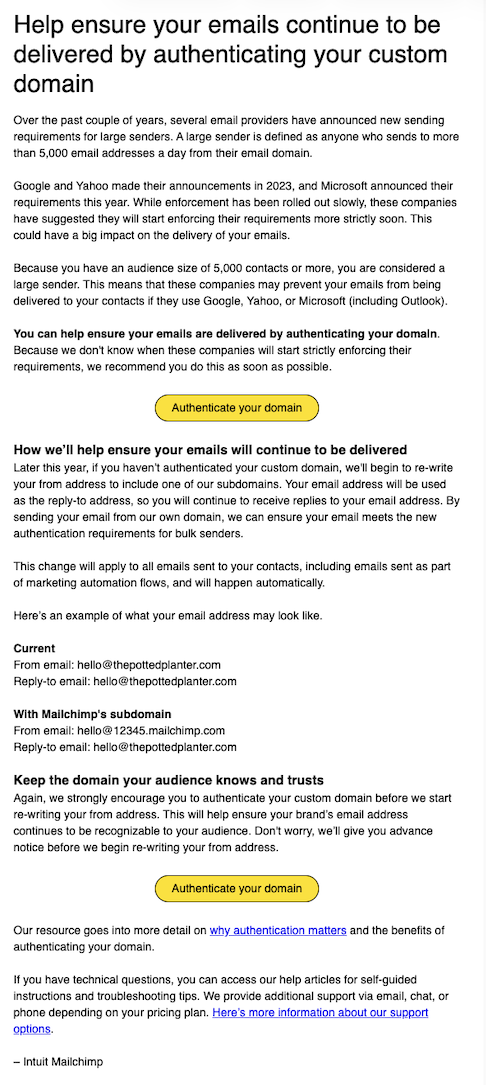
The first email we sent in part 2 of this project (we also sent a reminder), resulted in a 22% click-to-open rate. We also saw a 450% increase in authentication in the days following the send. As with part 1 of the project, we weren’t able to do experimentation or testing, but there weren’t any other emails or new in-product messages, so the team felt the 450% increase was attributed to the email on its own.
Beyond that, this change never caused a lot of noise from customers, and there were no indications that people were churning due to this announcement.