
Pricing Update Comms Plan
How I told over a million customers Mailchimp’s prices were changing, while keeping churn, support volume, and press coverage quiet
Snapshot
Company: Intuit Mailchimp
Role: Principal Marketing Manager, Lifecycle: Customer Notifications
Scope: I led the communication strategy, including defining customer segments, writing messaging for customers and partners, and enabling customer teams. I collaborated closely with data analysts to check customer lists, and partnered with engineering to send the emails through our transactional email service. Additionally, I looped in corporate communications to develop internal comms, social media guidance, and a reactive media statement.
By the numbers:
1.3M+ customer accounts emailed
~7% average price increase communicated across legacy and newer marketing plans
23 cohorts, each with tailored messaging
Support contact volume stayed under 10% of total support volume following the announcement
Churn remained below projected levels
The Challenge: Deliver Bad News to Good People
A price increase is one of the hardest messages to deliver in a product-led company. Customers obviously don’t want to hear it and competitors would love to capitalize on it.
This is one of several pricing and plan-change comms I’ve led since they began in 2019. For this portfolio entry, I’m focused on our 2024 price increase.
Price increases are considered legally required transactional emails. Even if a customer’s price wasn’t immediately changing, we needed to let them know that it could change in the future if they moved into a different pricing tier. This expanded the scope of customers we’d need to contact.
My job was to create a communication strategy that was transparent, legally sound, and specific to each customer’s actual situation. All while making the increase feel so “business as usual” that customers would barely react.
Strategy: One Size Doesn’t Fit All
I approached the comms with a few decisions.
Match the message to the impact. We had customers getting an 11% increase, some getting no increase, and others who (lucky them) were getting a decrease. They needed different messaging.
I segmented out the cohorts, and developed distinct messaging for each. For unaffected customers, I made the email as unremarkable as possible. For customers seeing the largest increase, I had learned from previous messaging that we needed to give them the information that was important to them without sugar-coating the impact.
Pair hard news with real value. Even though they may not like it, people still want a reason why. I linked to our new features page without too much fanfare (a lot of people just wanted to send a newsletter and didn’t use the new features), and also leaned on behind-the-scenes improvements (faster delivery and page load times) that all customers benefited from.
With this price increase, we wanted to also give legacy customers a bonus. They were the longest tenured, most entrenched customers, and they’d seen a few price increases since 2019. I was able to pair their announcement with some genuinely good news: we were giving them access to a ton of advanced features previously served to newer marketing plans.
Sequencing the send. Mailchimp Partners got a week’s advance notice so they could prepare to support their clients. At-risk and high-value accounts heard the news a few days early, directly from their customer success managers.
The Work
Emails, emails, emails
I wrote 23 emails to cover every customer situation. Each email included the price increase, specific value story, and next steps. Every email led with the facts because burying the numbers erodes trust—plus, you know, legal requires it ;)
Teeing up for a successful send + post launch support
With so many cohorts and a handful of merge tags, list accuracy was a high priority. I regularly met with data analysts to verify the lists against the cohort definition, and created documentation for our operational teams to ensure each list was connected to the right email version.
We also chose to batch send the emails over 3 days, ensuring each customer got the legally required 30 days’ notice. This helped frontline teams manage their queues, giving customers faster responses at a stressful time.
Preparing everyone who'd get a question
Beyond the customer emails, I worked with corporate comms to develop a reactive media statement and social media response guidance. I wrote the partner announcement so agencies were prepared to support their clients. Finally, customer-facing teams got messaging guidelines to ensure alignment between the email and what customer were hearing from support specialists.
Executive eyes are watching
A decision to change the pricing strategy is one that the folks at the top have to agree to. Given that, I worked directly with the CFO throughout, and he presented the strategy to senior leadership, including the Head of Mailchimp, to confirm final sign-off.
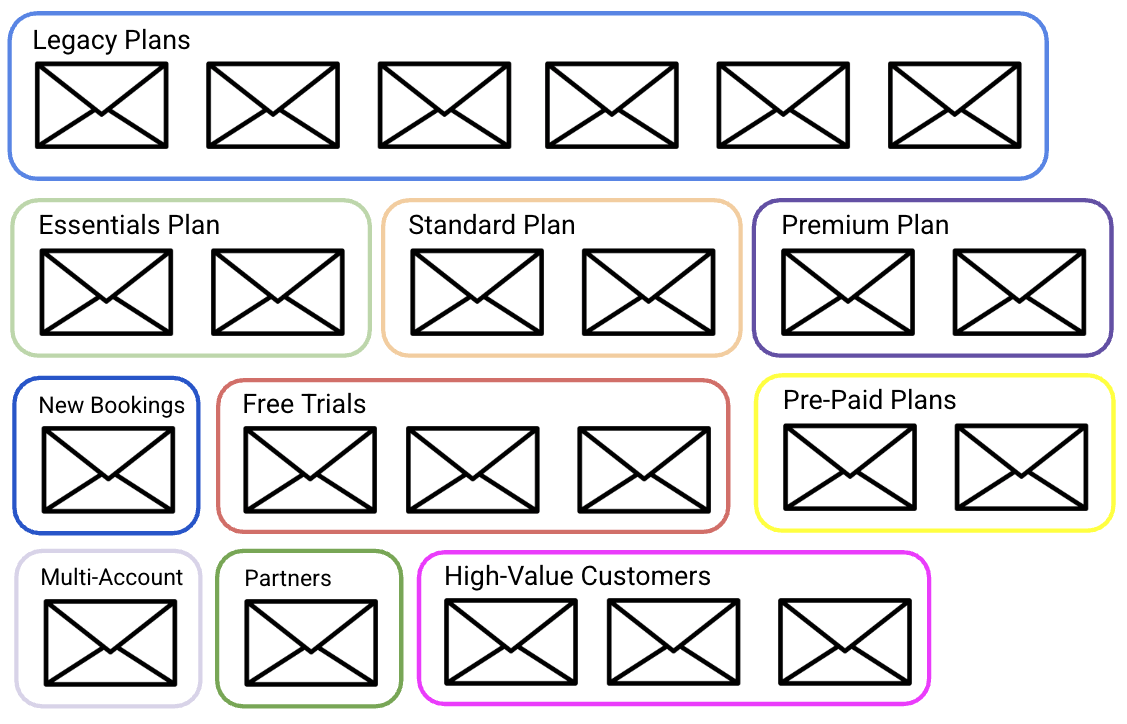
All 23 email variations, each with their own messaging
Results
You can’t not tell a customer their price is changing, so we couldn’t do testing to see how the emails impacted churn by themselves. Success with this type of communication is defined by what doesn’t happen: support isn’t flooded with tickets, churn doesn’t spike, and the news doesn’t become a major story on social channels.
By those measures, my communication strategy worked. When 1.3+ million people hear bad news, and the disruption is negligible, then I think it’s safe to say the segmentation and messaging did their job.
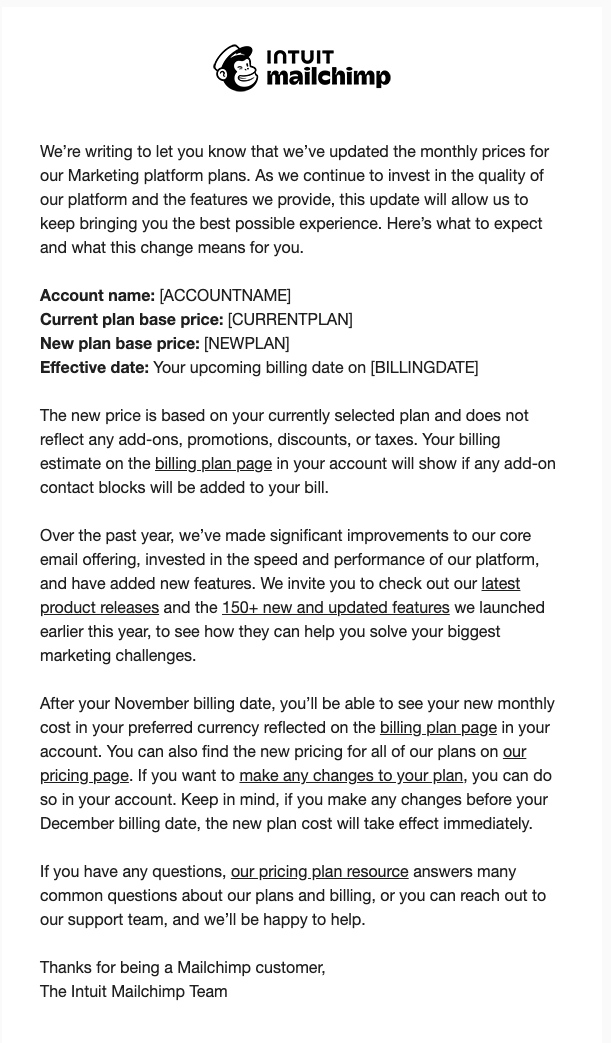
Just one version of 20+ emails